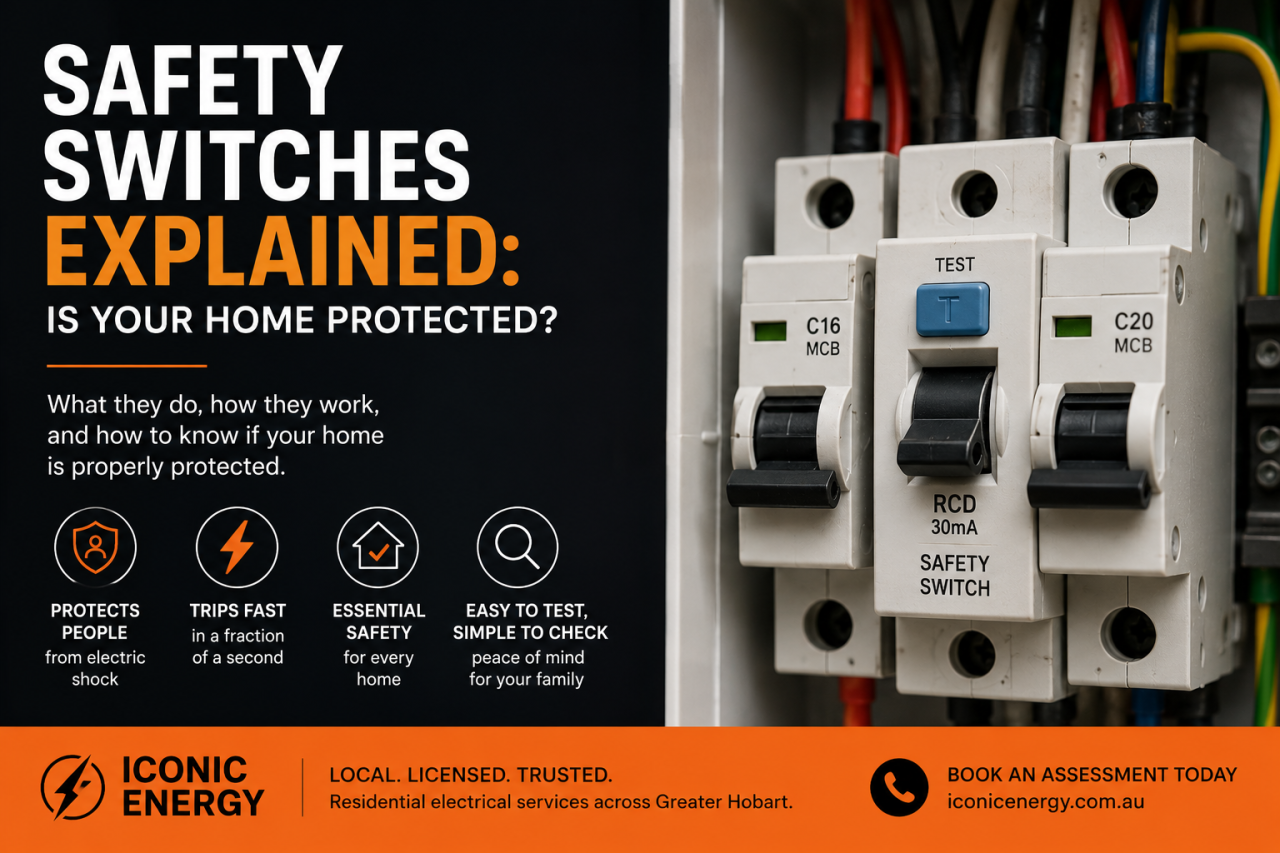
Most of us never think about the switchboard on the side of the house – until something trips. But tucked inside that board are the devices that can quite literally save a life: safety switches.
Despite how important they are, plenty of Tasmanian homes either don’t have enough safety switches, or don’t have any at all. This plain-English guide explains what a safety switch is, how it protects your home and family, and how to check whether you’re properly covered.
What is a safety switch?
A safety switch, technically called a residual current device or RCD, constantly monitors the flow of electricity through your circuits. If it detects electricity leaking to where it shouldn’t be – for example, through a damaged cord, a faulty appliance or a person – it cuts the power almost instantly.
That speed is what makes safety switches so effective. By shutting off the supply in a fraction of a second, they can prevent a serious electric shock from becoming a fatal one.
Safety switch vs circuit breaker vs fuse
One of the most common points of confusion is the difference between a safety switch, a circuit breaker and a fuse. They are not the same thing, and having one does not mean you have the others.
The simplest way to think about it: fuses and circuit breakers protect your wiring and your house from overload and fire, while safety switches protect people from electric shock. A well-protected home needs both types of protection.
| Device | What it protects | How it works |
|---|---|---|
| Fuse | The wiring (from overload) | A wire melts to break the circuit when current is too high. Must be replaced after it blows. |
| Circuit breaker | The wiring (from overload and short circuits) | Automatically switches off when current is too high. Can be reset once the fault is fixed. |
| Safety switch (RCD) | People (from electric shock) | Detects electricity leaking to earth and cuts power in a fraction of a second. |
How a safety switch protects you
In a healthy circuit, the electricity flowing out is balanced by the electricity flowing back. A safety switch watches that balance. The moment some of that current escapes – say, through a person touching a live part – the balance is lost and the switch trips.
Safety switches for personal protection are designed to respond to a leakage of just 30 milliamps, and they disconnect the power very quickly. Under Australian standards, this type of device must trip within 300 milliseconds, and in a serious fault it typically operates far faster — well inside the time that would cause lasting harm.
That combination of sensitivity and speed is why safety switches are considered the most important electrical safety device in any home.
How many safety switches should your home have?
Australia’s wiring rules require safety switch protection on new and altered circuits, including power points and lighting. In an ideal setup, every final circuit in the home is covered – not just the power points.
Many older homes fall short of this. Some have a single safety switch covering only part of the house; others have none at all, particularly on lighting, oven or hot water circuits. If a circuit isn’t protected by a safety switch, the people using it aren’t protected either.
A licensed electrician can check your board and tell you exactly which circuits are covered and which aren’t, so you know where the gaps are.
Signs your home may not be properly protected
You may not have adequate safety switch protection if your switchboard has no visible test buttons, if it still uses ceramic or rewireable fuses, or if only some of your circuits appear to be covered.
Homes built before safety switches became standard are the most likely to be under-protected. If you’re unsure – or if you’ve never had the board checked – it’s worth booking an inspection rather than assuming you’re covered.
How to test your safety switches
Safety switches have a test button, usually marked ‘T’ or ‘Test’. Pressing it should immediately switch off the power to the circuits that device protects, which confirms it’s working. It’s a good habit to test them roughly every three months, and after any power outage.
If a safety switch doesn’t trip when you press the test button, or won’t reset afterwards, stop using it and have a licensed electrician check it. A safety switch that doesn’t work offers no protection at all.
Getting safety switches installed in Hobart
If your home is missing safety switches, or only some circuits are covered, adding proper protection is one of the most worthwhile electrical upgrades you can make. It’s usually a straightforward job for a licensed electrician, often done as part of a switchboard upgrade.
Iconic Energy provides residential electrical services across Greater Hobart, including safety switch and switchboard upgrades, with honest advice and clear pricing. Get in touch for an assessment and a straightforward quote.
Frequently asked questions
What is the difference between a safety switch and a circuit breaker?
A circuit breaker protects your wiring by switching off when the current is too high, guarding against overload and fire. A safety switch (RCD) protects people by detecting electricity leaking to earth and cutting the power in a fraction of a second. A safe home needs both.
How many safety switches do I need?
Australia’s wiring rules require safety switch protection on new and altered circuits, and ideally every final circuit in the home – power, lighting, oven and hot water – should be covered. A licensed electrician can check your board and identify any unprotected circuits.
How do I test my safety switch?
Press the test button, usually marked ‘T’, on the device. It should immediately cut power to the circuits it protects. Test your safety switches roughly every three months and after any power outage, and call an electrician if one fails to trip or reset.
Do safety switches really save lives?
Yes. By cutting power almost instantly when electricity leaks to earth – such as through a person – safety switches can prevent a serious electric shock from becoming fatal. They are widely regarded as the most important electrical safety device in the home.
My home has no safety switches. Is that legal?
Older installations that predate current rules aren’t automatically illegal, but any new or altered circuits must have safety switch protection. Given how important they are for protecting people, it’s strongly recommended to have them fitted. A licensed electrician can advise on your specific situation.