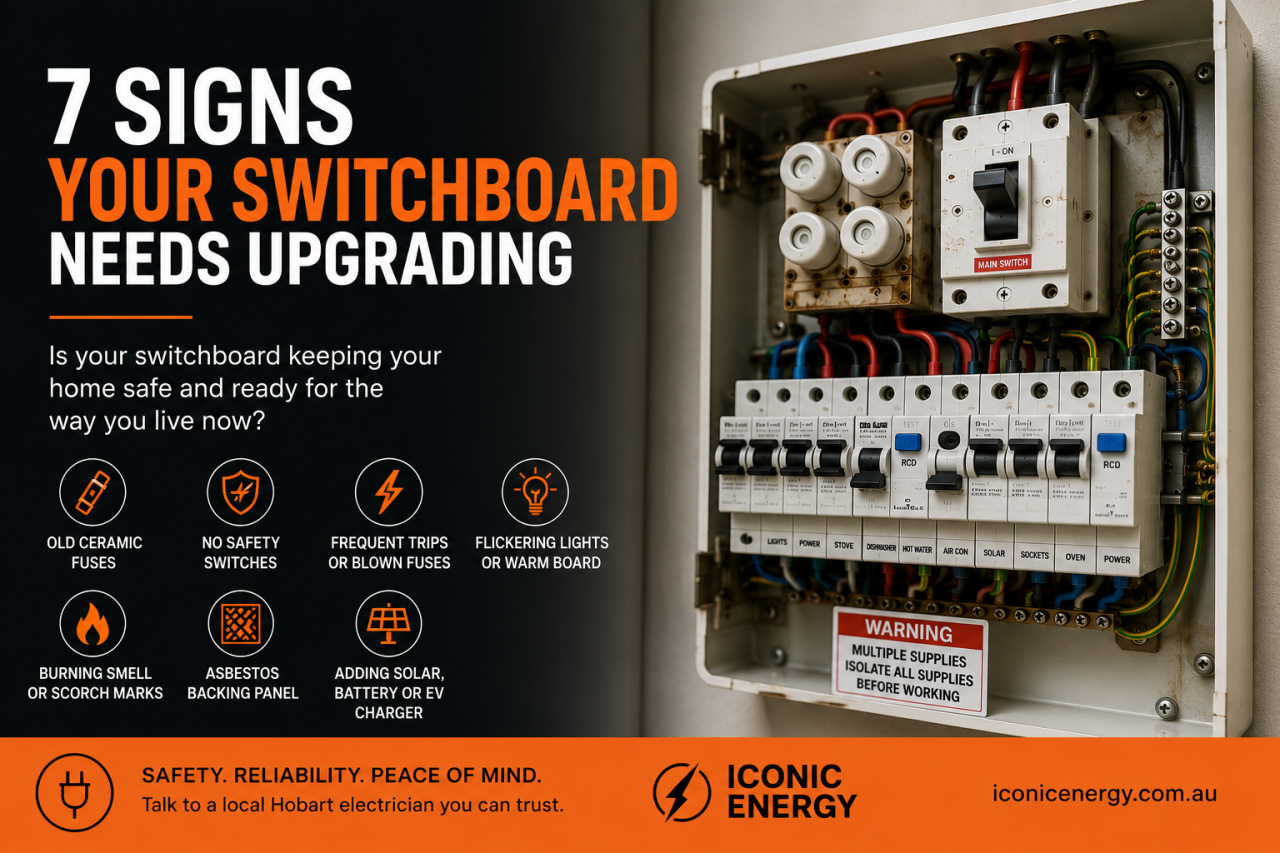
Your switchboard is the heart of your home’s electrical system. It takes the power coming in from the grid and safely distributes it to every light, power point, and appliance in the house – while protecting you and your family if something goes wrong.
The trouble is that many Hobart homes, especially those built before the 1980s, still run on switchboards that were never designed for the way we use electricity today. Heat pumps, induction cooktops, EV chargers, solar and batteries all place demands on a board that older fuses simply can’t keep up with.
So how do you know when it’s time to act? Here are seven clear signs your switchboard needs upgrading – plus what an upgrade typically involves and costs here in Tasmania.
First, what does a switchboard actually do?
A switchboard is the central panel – sometimes still called a fuse box – that controls and protects the electrical circuits in your home. It splits the incoming supply into separate circuits for lighting, power, hot water and larger appliances.
A modern board also holds the safety devices that protect your home: circuit breakers that guard the wiring against overload, and safety switches (RCDs) that protect people from electric shock. If your board is old, undersized or missing these devices, it can quietly become both a safety risk and a bottleneck for the things you want to add to your home.
The 7 signs your switchboard needs upgrading
1. You still have ceramic or porcelain fuses
If your board uses old-style ceramic or porcelain rewireable fuses – the kind where you replace a length of fuse wire by hand – it’s a strong sign the board is decades old. These were standard in Australian homes built before the 1980s.
Ceramic fuses are slower and less precise than modern circuit breakers, and a board built around them usually predates today’s safety switch requirements. Upgrading to modern breakers and RCDs is a meaningful step up in both safety and convenience.
2. There are no safety switches on the board
Safety switches, also called RCDs, are the devices that cut the power within a fraction of a second when electricity leaks to earth – such as through a frayed cord or a person. They are the single most important protection against electric shock and electrocution.
Many older Hobart boards have circuit breakers or fuses but no safety switches at all, which means the wiring may be protected but the people in the home are not. If you can’t see any test buttons on your board, that’s a red flag worth acting on.
3. Fuses blow or breakers trip constantly
The occasional trip can happen with a faulty appliance. But if your fuses blow or breakers trip regularly, it usually means your circuits are overloaded or the board can no longer handle your household’s demand.
Nuisance tripping is your system telling you it’s stretched beyond what it was built for. Rather than living around it, an upgrade can add capacity and split loads across more circuits so everything runs reliably.
4. Flickering lights or a warm, buzzing board
Lights that flicker or dim when appliances switch on, or a switchboard that feels warm, hums or buzzes, can point to loose connections or an overloaded board. These are not quirks to ignore.
Warmth and buzzing at the board can indicate connections that are deteriorating – an early warning sign that should be checked by a licensed electrician promptly.
5. A burning smell, scorch marks or discolouration
Any burning smell, browning, scorch marks or melted plastic around your switchboard is a serious warning sign. It suggests heat damage from arcing or overloaded connections.
If you notice this, switch off appliances where safe to do so and arrange for an electrician to inspect the board as a priority. Damage like this can be a fire risk and shouldn’t wait.
6. Your board has an asbestos backing panel
Switchboards installed in older homes were often mounted on backing panels that contained asbestos. While undisturbed asbestos is generally low risk, any work on the board means that panel needs to be handled and removed safely by a licensed professional.
If your home dates from before the 1990s and still has its original board, it’s worth having the backing checked. A proper upgrade replaces the asbestos panel and brings the whole board up to current standards at the same time.
7. You’re adding solar, a battery, an EV charger or new appliances
Modern additions place new demands on your switchboard. Adding rooftop solar, a home battery, an EV charger, a heat pump or an induction cooktop often requires spare capacity and space on the board that older switchboards simply don’t have.
If you’re planning any of these upgrades, it makes sense to assess the switchboard first. Getting the board right up front avoids reworking it later and makes future additions – like a solar and battery system – far simpler to connect.
What does a switchboard upgrade cost in Tasmania?
Every home is different, so treat any figure as indicative until you have a quote based on your actual board and wiring. As a rough guide, a straightforward switchboard upgrade for a typical home generally falls somewhere between about $1,000 and $3,500.
The final cost depends on things like the number of circuits, the condition of your wiring, whether safety switches need to be added, whether an asbestos backing panel has to be removed, and whether the consumer mains need replacing. Larger homes, three-phase supply or extra remedial work can push the figure higher.
Unlike some mainland states, Tasmania does not currently run a dedicated switchboard upgrade rebate, so it’s best to budget for the full cost of the work. A local electrician can give you a clear, itemised quote after assessing the board.
What’s involved, and how long does it take?
A switchboard upgrade generally means isolating the power, removing the old fuses and protection devices, fitting a new enclosure with modern circuit breakers and safety switches, reconnecting your existing circuits, and testing everything before the power goes back on.
Most straightforward upgrades take a few hours, though jobs involving asbestos removal, rewiring or a mains upgrade can run to a full day. Your power will be off for part of the work, and your electrician should walk you through the plan and timing beforehand.
Do you legally have to upgrade?
There’s no blanket law forcing every homeowner to replace an older board that is still safe and functioning. However, electrical work in Tasmania must be carried out by a licensed electrician, who is required to test the installation and issue a certificate of electrical compliance for the work they do.
In practice, upgrades are often triggered by safety concerns, renovations, or the addition of solar, batteries or major appliances – points where bringing the board up to current standards is both sensible and, for the new work, expected. Honest advice from a licensed electrician will tell you whether an upgrade is needed now or can wait.
Talk to a local Hobart electrician
If you’ve spotted one or more of these signs, the safest next step is a proper assessment by a licensed local electrician who can tell you plainly whether your board needs upgrading – and if so, what it will involve.
Iconic Energy provides residential electrical services across Greater Hobart, including safety switch and switchboard upgrades, with honest advice and clear pricing. Get in touch for an assessment and a straightforward quote.
Frequently asked questions
How much does it cost to upgrade a switchboard?
As an indicative guide, a straightforward switchboard upgrade for a typical Tasmanian home generally costs somewhere between about $1,000 and $3,500. The exact price depends on your circuits, wiring condition, whether safety switches or an asbestos panel need attention, and whether the mains need replacing, so it’s best to get a quote based on your board.
What is a switchboard upgrade?
A switchboard upgrade replaces your old fuses and protection devices with a modern board fitted with circuit breakers and safety switches. It improves safety, adds capacity for modern appliances, and brings the board up to current electrical standards.
Can you upgrade a switchboard without rewiring the whole house?
In most cases, yes. A switchboard upgrade replaces the board and its protection devices while reconnecting your existing circuits, so a full rewire usually isn’t required unless the wiring itself is unsafe or degraded. Your electrician will let you know if any wiring needs attention.
How do I know if my switchboard is safe?
Warning signs include ceramic fuses, no safety switches, frequent tripping, flickering lights, a warm or buzzing board, and any burning smell or scorch marks. If you notice any of these, have a licensed electrician inspect the board.
How long does a switchboard upgrade take?
Most straightforward upgrades take a few hours. Jobs that involve asbestos removal, rewiring or a mains upgrade can take up to a full day, with the power off for part of the work.